


-
-
SMART telescopes: which one should you choose?
September 04 2026 -

What are the different types of clouds?
July 28 2026


Art and Astronomy: what do the paintings of Monet and Van Gogh reveal?
The sky, the Moon and the stars have fascinated artists for centuries, appearing in their works as elements rich in meaning. The stars, the constellations, the planets, the Sun and the Moon have often been depicted with great attention to detail and, when observed through the tools of astronomy, can reveal even more precise information.
Astronomy thus becomes an additional tool for interpreting a work of art, complementing art history and helping us better understand what the artist actually had before their eyes. By bringing together these two seemingly distant disciplines, it is sometimes possible to date a painting, identify the location from which the artist observed the landscape, and reconstruct the depicted sky with greater accuracy.
The person who turned these details into genuine investigative tools was Donald Olson, an astronomer and professor of physics at Texas State University, nicknamed “the celestial sleuth.” His method, known as forensic astronomy, combines the analysis of the Sun, Moon and stars with historical documents, astronomical calculations and field research, often carried out together with students and other researchers.
Thanks to this approach, Olson has been able to reconstruct with remarkable precision the times and places connected to several famous works of art, transforming the skies depicted in paintings into a genuine source of information.
One of the most fascinating examples of Olson’s work concerns one of the most celebrated paintings in the history of modern art: Impression, Sunrise, by Claude Monet. Painted in 1872, it is considered the work that gave the Impressionist movement its name.

Claude Monet (1840–1926). Impression, Sunrise. 1872. Oil on canvas. Musée Marmottan Monet.
Monet was one of the leading exponents of en plein air painting, or painting outdoors, a style that focuses on landscapes, plays of light, reflections on water, clouds and wind. All of this translates into rapid brushstrokes capable of capturing a fleeting moment and conveying the vivid sensation of a landscape. This is precisely what makes the painting so valuable: every element on the canvas, the quality of the light, the reflections on the sea and the position of the Sun is tied to a specific moment.
To determine the exact time when the work was created, the Texas professor’s team carried out an extraordinary multidisciplinary analysis, reconstructing: the geography of the port of Le Havre; astronomical calculations of sunrise; tidal data taken from historical nautical almanacs; and documentary research on the artist.
Olson immediately ruled out the possibility of a sunset: in the painting, the Sun was located in the east. This allowed him to narrow the field dramatically, since the Sun rises in that exact position only a few times a year. By cross-referencing the astronomical data with computer algorithms, the team reached its definitive conclusion: the painting was created on November 13, 1872, at 7:35 a.m. Olson was even able to identify the exact point from which Monet observed the scene, locating it in a room on the third floor of the Hôtel de l’Amirauté in Le Havre, from whose window the painter captured the dawn before his eyes.
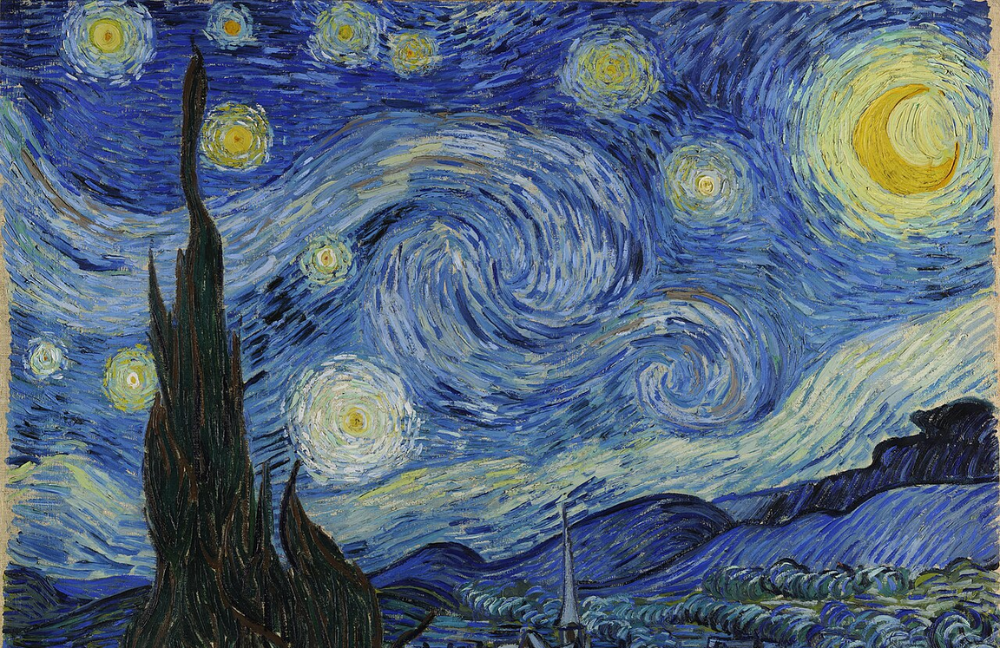
Among the masterpieces in which art and astronomy come together, Vincent van Gogh’s The Starry Night cannot be overlooked.

Vincent van Gogh (1853–1890). The Starry Night. 1889. Oil on canvas. Museum of Modern Art (MoMA)
Art historians agree that the painting was created in 1889, while Van Gogh was staying at the Saint-Paul asylum in Saint-Rémy-de-Provence. The east-facing window of his room was the vantage point from which the scene originated. The traditionally accepted dating places the execution of the work between June 16 and 18.
By comparing the positions of the celestial objects depicted in the painting, particularly the planet Venus and the Moon, shown as a waning crescent, with simulations generated by astronomical software, the closest match with the actual night sky falls a few days later, between June 21 and 23, shortly before dawn, at around 3:00 a.m.
The most likely explanation is that Van Gogh worked on the painting over the course of several nights, between late May and the summer solstice, gradually adjusting the phase of the Moon with deliberate artistic license. In 1986, historian Charles Whitney had already suggested another possibility: that the artist had constructed the sky from memory, combining visual impressions gathered over roughly a month of nighttime observations. Therefore, no exact and definitive date exists.
One of the most important aspects of The Starry Night is the way Van Gogh represents the stars. The painting does not simply feature white dots against a dark background: each star has its own structure, with colors that change from the center toward the edges and tones that vary from one celestial object to another.
This detail reflects, at least indirectly, an awareness of the discoveries of 19th-century stellar spectroscopy, the discipline that had shown that stars have different colors depending on their physical nature. Astronomer and science communicator Camille Flammarion described these phenomena in his astronomy books, which circulated widely in the cafés, bookshops and intellectual circles of Paris that Van Gogh frequented between 1886 and 1888.
The turbulent skies and the large central vortex of The Starry Night have long been interpreted as a visual projection of the artist’s psychological distress, while he was confined to the asylum against his will. It is an understandable interpretation, but one that astronomical reconstructions call into question: the sky visible from the asylum window was, in fact, surprisingly similar to the one depicted on the canvas.
Monet and Van Gogh are just two of the many artists who, over the centuries, have found inspiration in the night sky, seeking to capture its fascination in their works.
These two cases show how art and astronomy, despite being seemingly distant disciplines, can work together to solve, or at least reassess, historical mysteries and offer new interpretations of works we thought we already knew well.
Sources consulted:
laria Baratta. Astronomia per conoscere l'arte. Finestre sull'Arte. (2014). Url: www.finestresullarte.info/opere-e-artisti/astronomia-per-conoscere-l-arte
Edvige Corbelli. DEPICTIONS OF A LUNAR ECLIPSE AND THE DAWN OF ASTROPHYSICS IN VAN GOGH’S PAINTINGS. 2025, 28(1): 240-256. DOI: 10.3724/SP.J.140-2807.2025.01.14.
Rossella Spiga. I cieli di Van Gogh, Media INAF. (2025). Url: www.media.inaf.it/2025/06/19/astronomia-van-gogh/