


Player One Astronomy Ceres-462M USB3.0 Mono Camera (IMX462)

Player One Astronomy Ceres-462M USB3.0 Mono Camera (IMX462).
Resolution 1944x1096 px, pixel size 2.9 µm, 2.1 MPx.
Player One Astronomy Ceres-462M USB3.0 Mono Camera (IMX462)
Player One's auto-guiding camera series is designed for auto-guiding and imaging applications. The Ceres-462M model implements the Sony IMX462 CMOS sensor.
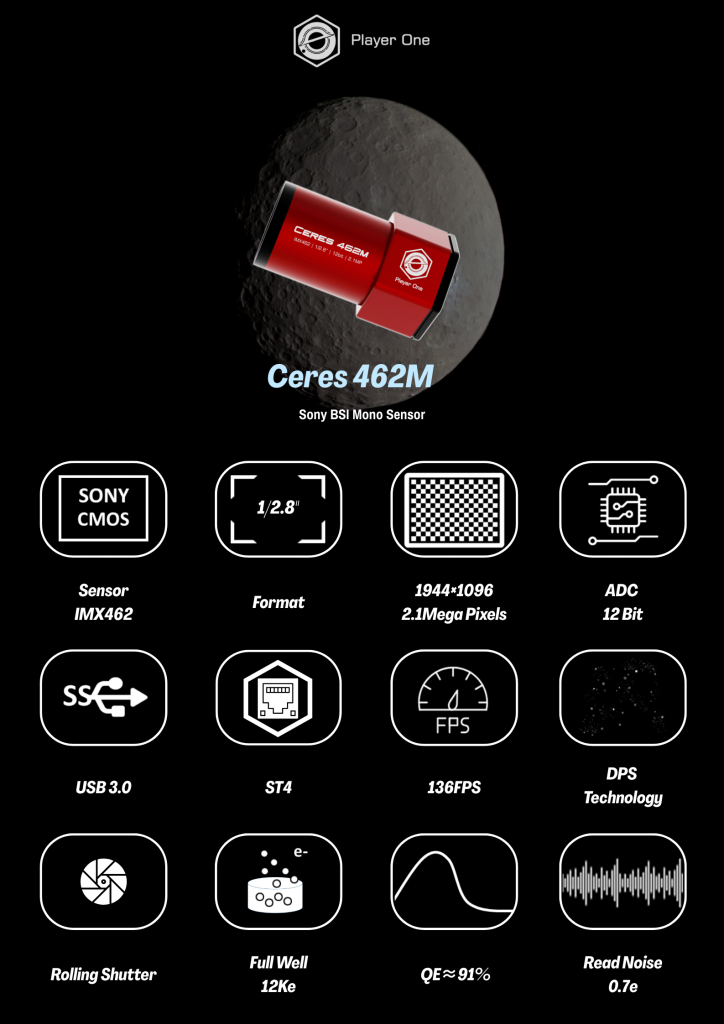

All Player One Astronomy guiding cameras include a USB 3.0 port with bandwidth up to 500 Mbps. For comparison, a USB 2.0 connection goes up to about 60 Mbps. They can therefore also be used profitably for high-speed lucky imaging of the moon and planets.
The format of these cameras is the classic 1.25" barrel and they can therefore be inserted into an eyepiece holder of the same diameter, such as the one that is normally available on commercially available compact guiding telescopes.

Features
Cutting-edge design
The guiding cameras developed by Player One Astronomy use a regular technological hexagon to construct the main body line.
DPS Technology
Player One Astronomy's guide cameras are equipped with a technology called DPS (Dead Pixel Suppression). The DPS technology analyses many dark frames to identify fixed anomalous pixels and records the map in the camera's memory. During imaging, at each exposure frame, the position of dead pixels is assigned a median value based on the active pixels around that anomalous pixel.

Overvoltage and overcurrent protection mechanism
Player One Astronomy integrates an over-voltage and over-current protection mechanism to safeguard the integrity of its own or possibly connected equipment.
Data port
When the camera is connected to the USB3.0 interface and full resolution preview is used, 136 FPS can be reached in RAW8 mode (10-bit ADC). When recording images, since the actual write speed will be affected by the write speed of the hard drive itself, when the write speed of the hard drive is low, recording may not reach the theoretical maximum speed. It is recommended to use a high-quality solid-state drive to record data in order to take full advantage of the camera's performance.
Use the ST4 guiding cable to connect the camera and the AUTO GUIDE port of the equatorial mount for guiding.
Performances

Read noise
As far as reading noise is concerned, the manufacturer performs real tests in the field. For users, Sharpcap 4 can be used for testing. Sharpcap 4 has a function called Sensor Analysis that provides a very simple way to measure read-out noise.
After several rigorous read-out noise tests, the Player One Astronomy Ceres 462M camera is able to achieve a low read-out noise of 1.1 e- with a gain set to 80.
Quantum efficiency

Mechanical diagrams

In the box

| Product Status | New |
|---|---|
| Package width | 8 cm |
| Package height | 9 cm |
| Package depth | 20 cm |
| No. of parcels | 1 |